
細胞計數器、分粒器及培養基分析儀
自 1954 年發明原版「庫爾特計數器」以來,我們已建立了創新的全系列產品,簡化細胞計數、大小測定、存活率分析及細胞培養監測系統,為您在生命科學中開拓新的可能性。
我們構思出的每一個解決方案都以您,以及您需要的效能、準確度與工作流程效率為出發點。內建可靠的工程技術,讓您可以持續仰賴儀器達成您的實驗室需求。我們不斷推出創新技術,將細胞計數器全系列產品的工作流程提升至最高境界,包括我們的 細胞計數液存活率平台與 Multisizer 4e 粒子大小分析儀。
每台儀器皆採用不同方法,以引領業界的精密科技協助您計算、測量大小並監測細胞健康狀態。這些平台功能強大、多工能、精確,但仍可讓使用者駕輕就熟。因此,無論您尋找的是全自動化、詳盡的結果,或者僅僅是業界無與倫比的可靠性,一定能擁有符合您需求的解決方案。

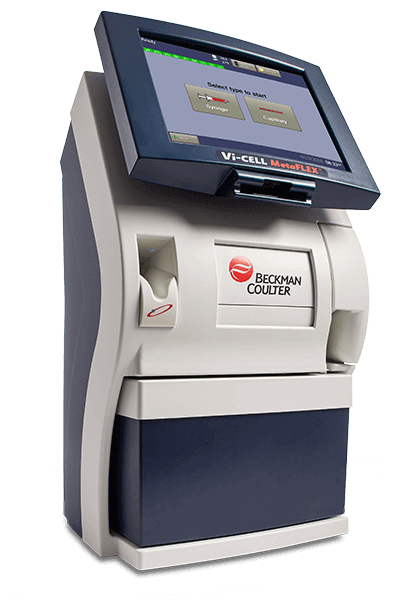
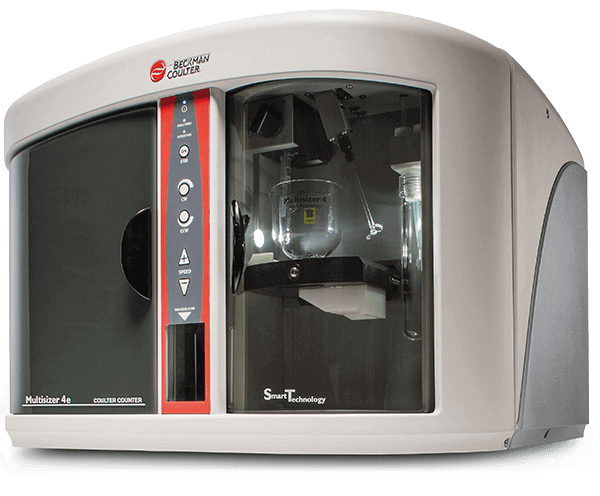
FAQ on Cell Counters, Sizers and Media Analyzers
What is a Coulter Counter?
A Coulter Counter counts and sizes particles suspended in an electrically conductive liquid by measuring changes in electrical impedance as individual particles pass through an aperture. Each detected pulse represents a particle event, while pulse amplitude is proportional to the volume of electrolyte displaced by the particle. When the analyzed sample volume is known, the measurements can also be used to determine particle concentration. The Multisizer 4e Coulter Counter applies this method to individual-particle counting and sizing.
The Coulter Principle is used to count and size particles suspended in an electrically conductive liquid. As particles pass individually through an aperture between two electrodes, each particle displaces electrolyte and produces a temporary change in electrical impedance. The number of pulses corresponds to the number of detected particles, and the amplitude of each pulse is proportional to particle volume. These data can be used to calculate particle size distribution and concentration.
When should a Coulter Counter be used instead of flow cytometry?
A Coulter Counter is appropriate when the primary objectives are to determine individual-particle count, concentration and volume-based size distribution without relying on fluorescent labels or particle optical properties. Samples must be suspended in an electrically conductive liquid and matched with an appropriate aperture.
Flow cytometry may be more appropriate when the study requires fluorescence-based identification, biomarker expression data or differentiation of populations using multiple optical parameters. Method selection should be based on the required information, sample characteristics and analytical workflow.
What factors can influence cell viability measurements?
Cell viability results can be affected by sample handling, incubation conditions, reagent selection, timing of analysis, and cell type. Standardized protocols help improve consistency and ensure reliable viability assessments across experiments.
