
吊桶式轉子
吊桶式離心機轉子的功能特色為路徑長度全長、慢速運行時間以及優異的分辨率。
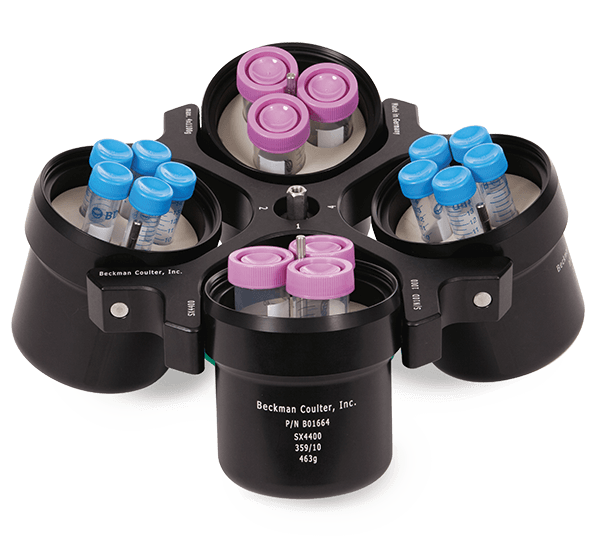
吊桶式轉子允許離心管在運行時改變角度。停止時吊桶為垂直,而運行時則為水平。吊桶式轉子的平行幾何結構允許樣本在密度梯度間移動不受阻礙,不同於定角的幾何結構,樣本碰觸到管壁並形成拖尾汙跡,不利於分離。
最適合以低速分離大量樣本,當樣本在速率區帶 (密度) 梯度中分離時尤其有用。應用包括細胞組織培養處理、高通量方案,例如自生長中、血液收集試管裡以速率區帶分離 根據大小或質量來獲得全部細胞。




FAQ on Swinging-Bucket Rotors
Why use a swinging-bucket rotor for density gradient centrifugation?
Density gradient centrifugation requires samples to separate into distinct layers based on density. Because swinging-bucket rotors position tubes horizontally during operation, they help create uniform gradients and well-defined sample bands, making them a preferred choice for many gradient-based separation workflows.
What applications are swinging-bucket rotors commonly used for?
Swinging-bucket rotors are frequently used for density gradient centrifugation, blood processing, bioprocessing workflows, and when highly purified samples are required . They are often selected when maintaining sample integrity and achieving high separation quality are important.
How does a swinging-bucket rotor work?
In a swinging-bucket rotor, sample tubes begin in a vertical position and gradually move to a horizontal position during centrifugation. This orientation allows particles to travel evenly through the sample, making swinging-bucket rotors especially suitable for density gradient separations and applications that require distinct sample layers.
What is the difference between a swinging-bucket rotor and a fixed-angle rotor?
A swinging-bucket rotor holds samples horizontally during centrifugation, making it well suited for density gradient separations and applications that require well-defined sample layers. They can also be used for pelleting and result in the pellet forming at the very bottom of the tube. A fixed-angle rotor keeps tubes at a constant angle and is typically preferred for rapid pelleting applications. The best choice depends on the separation objective and sample type.
What is a swinging-bucket rotor?
A swinging-bucket rotor is a centrifuge rotor that allows sample buckets to pivot during centrifugation. As rotational speed increases, the buckets swing outward into a horizontal position, creating a consistent linear sedimentation path that supports efficient sample separation.
